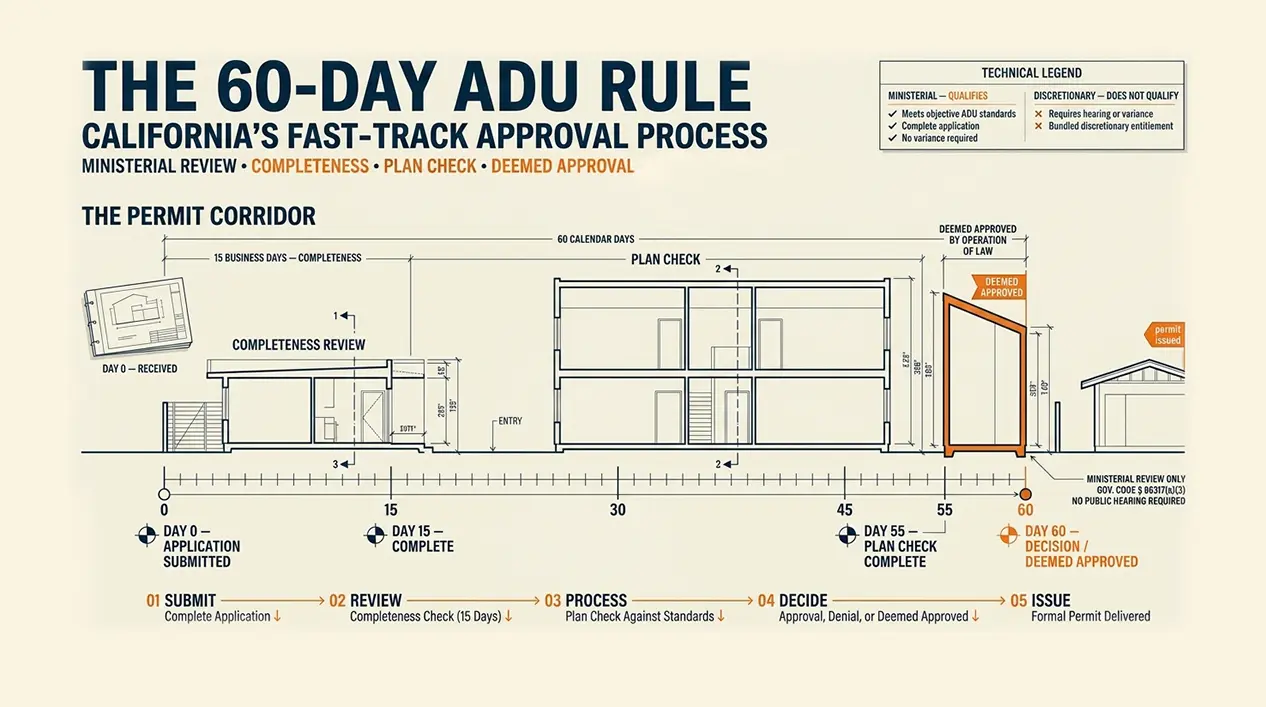
The 60-Day ADU Rule, California's Fast-Track Approval Process
If you've spent any time researching ADUs in California, you've heard the pitch: "cities have to approve your ADU in 60 days." It sounds almost too good to be true, especially if you've talked to a neighbor who waited five months for their permit. So which is it? Is the 60-day ADU rule real, or is it one of those things people repeat online without really understanding?
It's real. But it doesn't work quite the way most homeowners imagine, and it definitely doesn't mean every ADU gets rubber-stamped in two months flat. There's a specific legal mechanism behind it, a specific category of project it applies to, and a specific set of conditions that determine whether you actually land inside that window or blow past it.
Here's the short version: California law requires cities to approve or deny a complete, code-compliant ADU application within 60 days. If the city misses that deadline, the application is deemed approved by operation of law. That single rule has pushed typical ADU approval times down from four-to-six months to something closer to 30–50 days in a lot of jurisdictions. But it only applies to ministerial ADUs, and "complete application" is doing a lot of work in that sentence. Below is what the rule actually says, how the clock works, who qualifies, and what to do if your city is dragging its feet.
What the 60-Day Rule Is
The 60-day ADU rule comes from California's Planning and Zoning Law governing accessory dwelling units, historically codified at Government Code Section 65852.2(a)(3), and renumbered in 2024 to Section 66317(a)(3) (with an equivalent provision for JADUs at Section 66335). The 2024 renumbering moved most ADU statutes into the 66300 series, so if you see an older article citing "65852.2," that's the same law under its previous number, not a different requirement.
The rule itself is simple: once a local agency has a complete ADU application in front of it, it has 60 calendar days to approve it, deny it, or request corrections. It cannot sit on the file indefinitely, and it cannot send your project to a public hearing if the project meets the objective standards in your local ordinance and state law.
What that means for you, in practice:
- You submit a complete ADU application.
- The city has 60 days to issue a decision.
- If the city doesn't decide within that window, your application is deemed approved.
- You don't have to ask for this, it happens automatically, by law.
This only applies to ministerial review, projects the city approves based on an objective checklist, not planner judgment. Discretionary ADU applications (rare, but they exist) aren't covered by the 60-day clock.
How the 60-Day Rule Works
Here's the mechanical version, day by day.
Day 0, You submit. Your ADU application goes in with drawings, forms, and supporting documents. Get a timestamped receipt. This date matters.
Roughly Day 1–15, Completeness review. The city has up to 15 business days to tell you whether your application is complete. If it's missing something, they'll issue a list, and you'll need to submit the missing items before the substantive 60-day clock actually starts running.
Roughly Day 15–55, Plan check. This is the real review, checking your drawings against the objective standards in the local ordinance and state law. If everything's compliant, this moves toward approval. If there are issues, you get a corrections letter.
Day 56–60, Decision. The city issues a final call: approval, denial (rare, and only if the project genuinely doesn't meet standards), or, if corrections are still outstanding and the clock runs out, deemed approval.
One detail that trips people up: this is 60 calendar days, not business days. Weekends and holidays count against the clock. That's part of what makes it a meaningfully faster process compared to older discretionary timelines, which often ran on business-day counts with built-in continuances.
Who Qualifies for the 60-Day Rule
The rule applies to ministerial ADU applications. That's the whole test, and it's worth taking seriously because a lot of the confusion around this law comes from people assuming it covers every ADU project in the state.
Your ADU likely qualifies if it:
- Meets your city's objective ADU standards (size, setbacks, height, parking) and state minimums
- Is submitted as a complete application
- Doesn't require a variance, special exception, or discretionary design review
- Isn't tangled up with a separate discretionary approval (like a hillside development permit)
Your ADU does NOT qualify for the 60-day timeline if it:
- Requires discretionary review, a hearing, a design review board, or a conditional use permit
- Needs a variance from setback, height, or size standards
- Is bundled with another discretionary entitlement that isn't itself ministerial
- Sits in a jurisdiction with unresolved legal noncompliance issues affecting how it processes applications (uncommon, but it happens)
What Happens If Your Application Exceeds 60 Days
This is the part people find most interesting, and also the part most likely to be misunderstood.
If the city doesn't issue a decision within 60 days of a complete application, your project is deemed approved, approved by operation of law, without the city having to say so.
What that actually gets you:
- The city cannot deny the project after the fact.
- You have legal approval standing, even without a formal permit document in hand yet.
- The city is still obligated to issue the formal permit, deemed approval isn't a substitute for construction paperwork, it's a forcing mechanism to get one issued.
What it doesn't automatically get you: peace of mind. Deemed approval is a real legal protection, but a formal, city-issued permit in hand is cleaner for financing, inspections, and resale down the line. If you're approaching day 60 with no word from the city, the smart move is to follow up in writing, reference the statutory deadline, and ask for the formal decision, not just let the clock run out and hope for the best.
Strategies to Stay Under 60 Days
The single biggest lever is the quality of the drawing set you submit on day one:
- Submit permit-ready, code-verified drawings
- Submit a genuinely complete application
- Include a written code analysis sheet
- Respond to corrections immediately
- Call the city before submitting
- Track your own timeline
None of these guarantee 60 days. They stack the odds in your favor, and the single biggest lever by far is the quality of the drawing set you submit on day one.
Practical Guidance: Using the 60-Day Rule Strategically
Before submission: Confirm ministerial status with your city, get complete-application requirements in writing, and submit permit-ready, code-verified drawings with a clear code analysis sheet attached.
At submission: Get a timestamped receipt. That date is your day zero, and it's the reference point for every deadline that follows.
During the window: Track your own calendar against the city's, completeness determination, plan check progress, corrections if any, and the day-60 deadline. If you're approaching day 60 without a decision, follow up in writing and reference the statutory timeline.
At day 60: If approved, get the formal permit. If deemed approved, request the formal permit immediately rather than relying solely on the deemed-approval standing.
Common Questions About the 60-Day ADU Rule
Does the 60-day rule apply to my ADU?
If your project is ministerial, reviewed against an objective checklist rather than planner judgment, yes. Confirm directly with your city if you're unsure.
What happens if the city doesn't decide in 60 days?
Your application is deemed approved by operation of law. The city still owes you a formal permit.
Can my city opt out of the 60-day rule?
No. It's a state law requirement that applies statewide, with no jurisdiction-level opt-out.
Does the 60-day clock include weekends?
Yes, it's 60 calendar days, not business days.
What's a "complete application"?
All required forms, drawings, code analysis, and fees, submitted together and accepted as complete by the city, which now must happen within 15 business days of submission.
Can corrections extend the 60-day timeline?
No, the clock doesn't pause for corrections. You're working within whatever time remains in the original 60 days.
The 60-day ADU rule is real, and it's genuinely changed how fast ADUs move through California cities. But it only does its job if you show up with a complete, code-compliant application.
Related reading: California ADU Laws 2026 · Ministerial vs. Discretionary Approval · ADU Permit Drawings · What "Permit-Ready" Means · How Plan Check Works · Why Plan Check Takes Long · Detached vs. Garage vs. JADU · an ADU package built for ministerial review