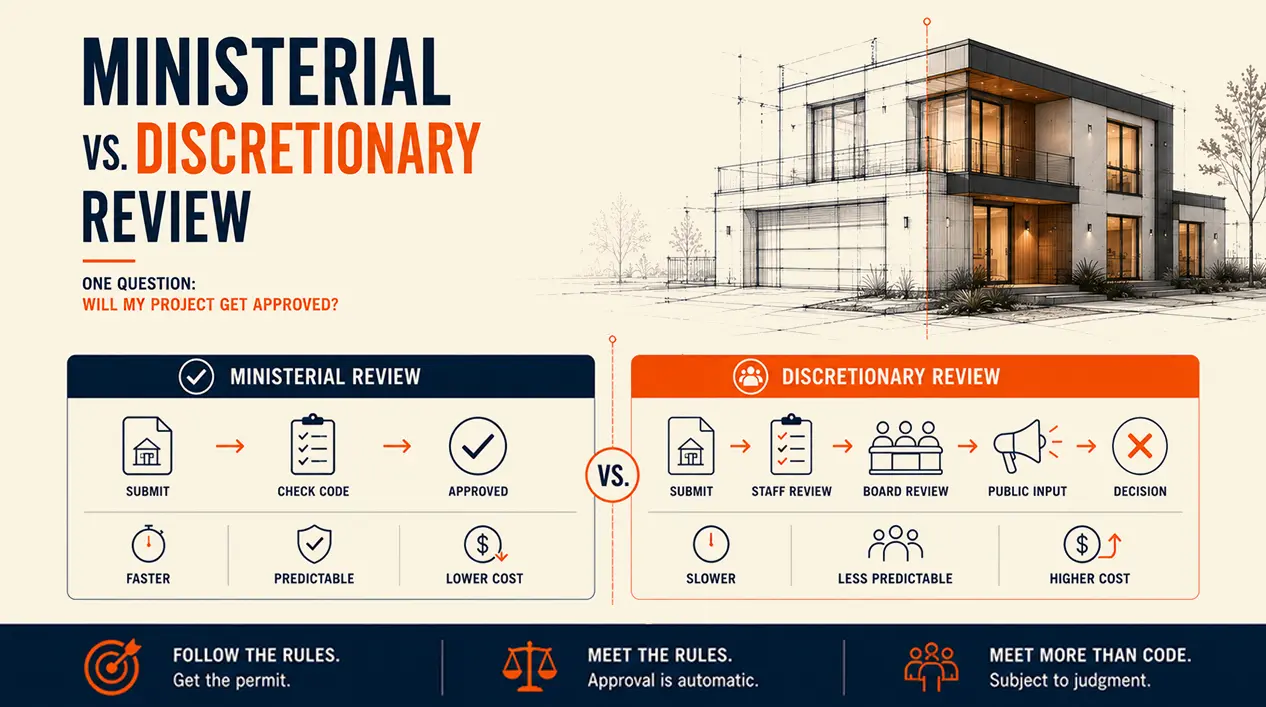
Your planning department mentions "ministerial review." Your drafter mentions "discretionary approval." You want to know one thing: is your project getting automatically approved because it checks the right boxes, or could someone on a planning board look at it and just say no, even if you did everything right? That's the real question underneath these two words, and it's worth understanding clearly, because it affects your timeline, your odds, and how much control you actually have over the outcome.
Here's the core distinction. Ministerial review means approval is automatic if your project meets every specific, objective code requirement, no judgment involved. If you're compliant, you get approved, full stop. Discretionary review means a planning body has actual decision-making authority beyond just checking code compliance, they can weigh in on neighborhood character, design compatibility, or broader planning goals, and they can say no even when your project technically complies with every written requirement. Ministerial is faster, more predictable, and harder to deny. Discretionary is slower, less certain, and genuinely involves someone's judgment call. Here's exactly how each one works, and how to tell which one applies to you.
The core difference
Ministerial review is a checklist exercise. The reviewer verifies specific, objective requirements, setback distance, height limit, parking count, and if every box is checked, approval follows automatically. There's no room for "we don't love the design" or "this doesn't fit the neighborhood." If you meet the requirements, you're approved, and that's essentially the entire process.
Discretionary review adds a layer of judgment on top of code compliance. A planning board or commission evaluates not just whether you've met the written rules, but whether the project aligns with broader planning goals, neighborhood compatibility, or community input. This means a project can be fully code-compliant and still get denied, modified, or delayed based on that judgment call.
Real-world examples
Ministerial, in practice: an ADU application that meets every applicable size, setback, and parking requirement under a state or local ADU law designed for ministerial review. The reviewer confirms compliance against the checklist, and approval follows, there's no mechanism for the city to say "we'd rather not have an ADU on this street." If the requirements are met, approval is close to guaranteed.
Discretionary, in practice: a home addition in a jurisdiction where additions go through planning board review. The addition meets every setback and height requirement on paper, but the planning board considers it architecturally out of step with the surrounding block and either requests design changes or, in some cases, denies it outright. Code compliance here is necessary but not sufficient, the board's judgment is a real, additional hurdle.
Why this distinction matters
Approval likelihood. Ministerial projects that meet code are approved at a very high rate, there's essentially no path to denial once compliance is confirmed. Discretionary projects carry real uncertainty even when fully compliant, since planning judgment introduces a variable outside your direct control.
Timeline. Ministerial review is a straightforward compliance check, commonly running four to six weeks total. Discretionary review adds planning board scheduling, potential public notice periods, and sometimes a formal hearing, commonly stretching to eight to twelve weeks or longer, especially if an appeal follows a denial.
Public process. Ministerial review typically has no public hearing component, it's an administrative check, not a public proceeding. Discretionary review often includes a public notice period and sometimes a hearing where neighbors can weigh in, which adds both time and an element of community politics to the outcome.
Cost. Ministerial review is generally the cheaper path, a straightforward compliance review. Discretionary review can cost more, particularly if you need an architect or consultant to help present and defend the design at a hearing.
Appeal options. Ministerial decisions have limited grounds for appeal, mostly because there's little to appeal, if you were denied, it's because you didn't meet a specific requirement, and the fix is meeting it, not arguing the decision. Discretionary decisions carry more extensive appeal paths, since the underlying judgment call itself can be challenged, sometimes up through city council or even court.
Ministerial review, explained
Here's what actually happens: you submit your project, the reviewing body checks it against explicit, written code requirements, and if every requirement is met, it's approved. If not, you get a corrections letter and a chance to fix and resubmit.
Picture the actual checklist: setback required 25 feet, proposed 28 feet, pass. Height limit 35 feet, proposed 22 feet, pass. Lot coverage maximum 50%, proposed 45%, pass. Parking requires one space, one space provided, pass. All pass means approved. There's no line item for "does the reviewer like it", that's not part of the process.
Ministerial review shows up when state law mandates it for certain project types (ADU laws in a growing number of states are the clearest current example), when local code specifically designates a project type as ministerial, or occasionally under other legal mandates. The advantages are real: faster approval, genuine predictability once you know you're compliant, no exposure to subjective denial, and generally lower overall cost.
Discretionary review, explained
Here, the process layers judgment on top of compliance. You submit, the reviewing body checks code compliance and evaluates against planning principles, and if it's compliant but the planning board doesn't approve of it on other grounds, you can still be denied or asked to make changes.
The evaluation looks something like: does it meet code requirements (an objective check), is it compatible with the neighborhood (a subjective judgment), does it align with the city's broader planning vision (a policy judgment), and what does the public think (community input, sometimes gathered formally through a hearing). Even with every code box checked, a planning board can determine the project isn't right for that location and decline it.
Discretionary review is the default for many traditional project types, additions and renovations in many jurisdictions still fall here, or shows up when local code specifically routes a project type through planning board review. The tradeoffs: slower approval, real unpredictability since a board's judgment isn't fixed the way a checklist is, exposure to denial on subjective grounds, generally higher cost if you need professional support to present your case, and a public process that can invite neighbor objections and real delay.
Ministerial vs. discretionary, side by side
| Aspect | Ministerial | Discretionary |
|---|---|---|
| Approval basis | Code compliance only | Code compliance plus planning judgment |
| Approval is | Automatic if compliant | Subject to a planning body's decision |
| Can be denied for | Not meeting code | Not meeting code, or planning/design concerns |
| Typical timeline | 4–6 weeks | 8–12+ weeks |
| Public hearing | Usually none | Often included |
| Approval likelihood if compliant | Very high | Uncertain, depends on judgment |
| Typical cost | Lower | Higher |
| Appeal options | Limited | More extensive |
Below is a visual comparison of the typical timeline gap between the two.
ADU laws and the shift toward ministerial review
This is one of the most significant recent developments in residential permitting, and it's worth understanding regardless of where you live. A growing number of states have moved ADU approvals toward mandatory ministerial review specifically, meaning that if your ADU meets the applicable state and local requirements, the city cannot deny it on subjective grounds like "we don't think this fits the neighborhood." California's ADU legislation is the best-known example of this shift, and other states have moved in similar directions to varying degrees.
This matters because ADUs were historically often subject to discretionary review, where a city could decline a project for reasons entirely unrelated to code compliance. Moving qualifying ADUs to ministerial review removes that subjective layer, but it doesn't remove the requirements themselves. The size limits, setback rules, parking provisions, and (in some jurisdictions) owner-occupancy requirements still apply in full, and an ADU that doesn't meet them can still be denied. What changes is that meeting them is now genuinely sufficient, there's no remaining discretionary hurdle standing between compliance and approval.
Since ADU rules vary significantly by state and city, as covered in our Texas and Florida ADU guides, confirm directly with your specific jurisdiction whether your ADU qualifies for ministerial treatment, since that answer materially changes both your timeline and your certainty of approval.
How to tell which one applies to your project
Start by asking your planning department directly: "Is my [project type] reviewed ministerially or discretionarily?" Most departments can answer this immediately, since it's a fixed feature of how they've structured their review process for that project type.
You can also check your local zoning ordinance or development code directly, looking for the word "ministerial" attached to specific project types, or conversely for "conditional" or "conditional use," which tends to signal discretionary review. Language distinguishing a "permitted use" from a "conditional use" often maps onto this same ministerial-versus-discretionary line.
If your project might qualify under a state-mandated ministerial category, ADUs being the most common current example, check your specific state's law directly, since these mandates vary in scope and specific qualifying requirements from state to state.
What ministerial doesn't mean
Ministerial doesn't mean no review happens at all, there's still a real compliance check, it's just not a discretionary one. It doesn't mean automatic approval regardless of your drawings, you still need to actually meet every requirement, and if you don't, you'll still get a corrections letter. It doesn't necessarily mean zero public visibility, some jurisdictions still post notice or accept comments even on ministerial reviews, though typically without a formal hearing. And it doesn't mean you can't appeal, you can, but the appeal is narrowly about whether the code was applied correctly, not about whether the code itself should apply to you.
What discretionary doesn't mean
Discretionary doesn't mean a planning board can deny anything for any reason, there are still legal limits on arbitrary denial, and code compliance remains a real factor even if it's not the only one. It doesn't automatically mean a formal hearing, some discretionary processes include one, some don't, depending on the jurisdiction's specific structure. It doesn't mean your neighbors can single-handedly block your project, they can comment and raise concerns, but the planning board makes the actual decision. And it doesn't mean denial is likely, most discretionary projects are ultimately approved; the process is simply less automatic and more variable than ministerial review.
How to plan around each type
If your project is ministerial: verify you meet every applicable requirement before investing in a full drawing set, build an explicit compliance checklist, make sure your drafter understands the specific requirements your project needs to hit, and submit genuinely permit-ready drawings, since meeting the checklist is the entire game here. Expect a faster turnaround and minimal back-and-forth if you're actually compliant.
If your project is discretionary: budget meaningfully more time, prepare for the possibility of neighbor input or objections during a public comment period, consider whether professional design support is worth it to help present and justify your project if a hearing is involved, and think through your design rationale in advance, being able to explain why your project fits the neighborhood context can matter as much as the drawings themselves.
FAQ
What's the difference between ministerial and discretionary review?
Ministerial review approves projects automatically once they meet explicit code requirements, no judgment involved. Discretionary review adds a planning body's judgment on top of code compliance, meaning even a compliant project can be denied or modified based on broader planning considerations.
Which one is faster?
Ministerial review, generally by a significant margin, commonly four to six weeks versus eight to twelve or more for discretionary review, which often adds public notice periods and hearings.
Can a ministerial project be denied?
Yes, but only for failing to meet an explicit code requirement, not for subjective reasons. If you're compliant, ministerial approval is close to guaranteed.
Why would I want discretionary review?
You generally don't choose it, it's determined by your project type and jurisdiction. That said, discretionary processes do allow for some project types that wouldn't fit a rigid ministerial checklist to still get approved with adjustments or conditions.
Are ADUs ministerial or discretionary?
Increasingly ministerial in many states, particularly where specific ADU legislation mandates it, California is the most established example. Whether your specific ADU qualifies depends on your state and local requirements, so confirm directly with your jurisdiction.
How do I know if my project is ministerial?
Ask your planning department directly, check your local zoning code for the term or for related language like "conditional use" versus "permitted use," and check whether your project type falls under any state-mandated ministerial category.
What happens at a discretionary hearing?
A planning board or commission reviews your project, often after a public notice period, sometimes taking public comment from neighbors, before making a decision that can include approval, conditional approval, requested modifications, or denial.
Can I appeal a ministerial decision?
Yes, though the appeal is narrow, you're arguing that the code wasn't applied correctly, not that the code itself is unfair. If you're denied and it's because you don't meet a requirement, resubmitting compliant drawings is usually the faster path over a formal appeal.
The bottom line
Whether your project goes through ministerial or discretionary review changes almost everything about your experience: your timeline, your certainty of approval, whether the public gets a formal voice, and how much of the outcome is actually in your control. Ministerial review rewards precise code compliance with fast, predictable approval. Discretionary review requires that same compliance plus a genuine case for why the project fits its context.
If you're not sure which category your project falls into, or you want drawings built specifically to clear whichever review type applies to you, we start by confirming that with your jurisdiction, before you invest in a full drawing set. Start with permit drawing services, or see How Plan Check Works for how this distinction fits into the broader approval process.