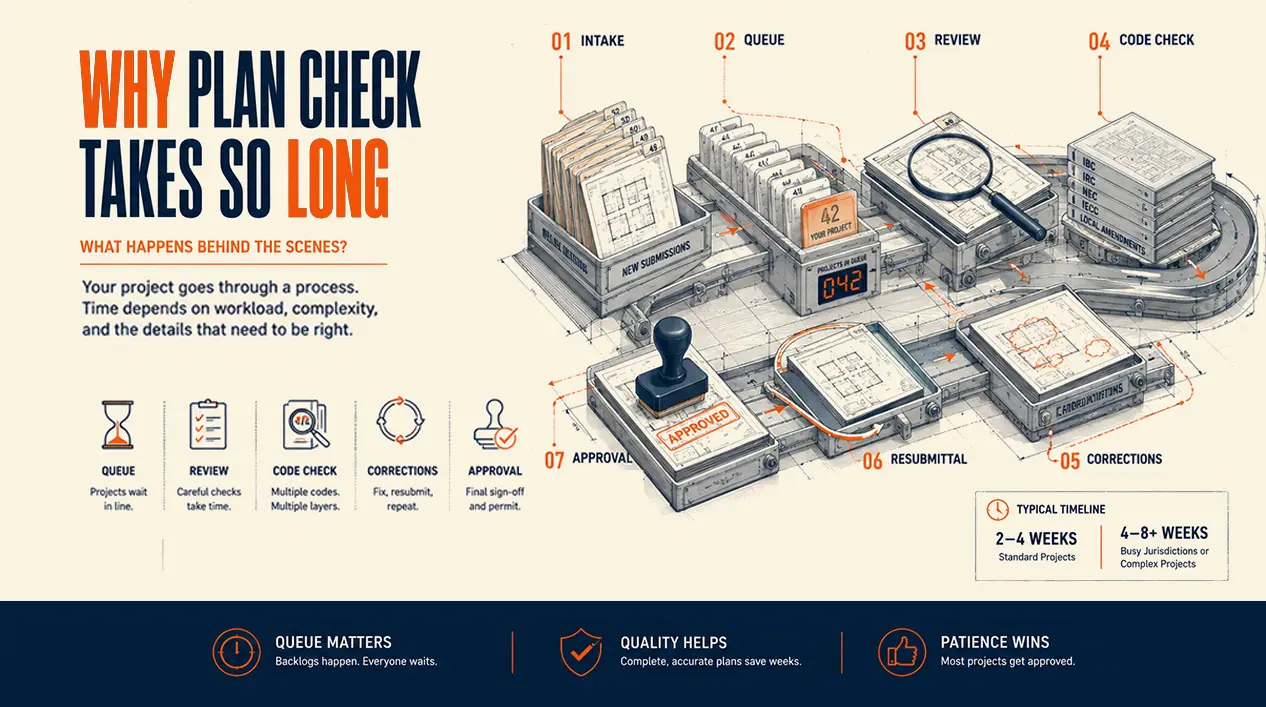
It's been three weeks. Maybe four. You checked the online portal again this morning and nothing's changed. Your contractor's asking when you'll have a start date, and you don't have an answer. You're starting to wonder if something's actually wrong, or if this is just... how it is. Here's the honest answer: this is probably just how it is, and you're not imagining the slowness.
Plan check typically takes two to four weeks, but it regularly stretches to four to eight weeks in busy cities or for more complex projects, and sometimes longer than that. Building departments are commonly understaffed relative to their workload, thorough review is genuinely time-consuming, and your project is one of dozens sitting in a queue that isn't moving as fast as anyone would like, including the plan checker working through it. Here's why this happens, what's actually normal, what should raise a flag, and what you can actually do about it.
The honest answer
You paid your permit fee. Your drawings seem simple. Why is this taking so long? The reality is that building departments are commonly stretched thin, plan checking is detailed work that resists shortcuts, and there are likely dozens of other projects ahead of yours in the same queue. Two to four weeks is normal. Four to eight weeks happens regularly, especially in busier jurisdictions or during peak season. Longer delays happen sometimes, and while frustrating, this usually isn't a sign that anything has gone wrong with your specific project.
Why building departments are slow
Understaffing is common. Many building departments run with just one to three plan checkers covering the entire jurisdiction's project queue, and each one might be juggling 50 to 100 active projects at once. One plan checker taking vacation can add real delay across the board. One leaving the position entirely can mean months of disruption while a replacement is hired and gets up to speed, and plan checker roles often pay less than comparable private-sector positions, which makes retention a genuine, ongoing challenge for many cities.
Workload swings seasonally. Spring and summer bring a surge of permit submissions as everyone wants to build before the good weather ends, and a department's backlog can stretch from two weeks to eight weeks within a single month during that stretch. Fall and winter tend to run lighter, with correspondingly shorter waits. If you submitted during peak season, expect the longer end of the range.
Complex projects genuinely take time. A simple deck review might take a plan checker two or three days of actual attention. A complex multi-story or commercial project can take four to six weeks. Your project might be simple, but the plan checker reviewing it is also working through other people's complex projects in the same queue, and that competing workload affects everyone's timeline.
Real thoroughness takes real time. A genuine plan check means reading every sheet carefully, checking against multiple applicable code sections, verifying dimensions actually match across the whole set, sometimes consulting a structural engineer, sometimes coordinating with another department, and writing a detailed corrections letter if something's off. None of that is fast. It's meticulous, and that's actually the point.
Interdepartmental coordination adds real delay. Some projects need sign-off beyond the building department itself, the fire department for life-safety elements, public works for drainage or utilities, environmental review for wetlands or similar concerns, planning for zoning-specific questions. Each of those departments runs its own separate queue, and waiting on more than one compounds your overall timeline.
Common causes of delays, beyond the baseline wait
Errors in your drawings. The plan checker finds conflicting dimensions or missing information and sends a corrections letter, which you then have to address and resubmit, commonly adding two to four weeks.
Straightforward backlog. Nothing's actually wrong with your submission; your city is simply busy, and your project sits behind fifty others in line. This alone can add two to four weeks beyond the "normal" baseline.
A zoning issue surfaces. The plan checker flags a potential setback or zoning concern and routes it to the planning department for verification, which runs on its own timeline, commonly adding two to four weeks.
Structural questions come up. The plan checker has concerns about a structural element, especially if there's no engineer's stamp involved, and requests engineering review or calculations, which then requires hiring an engineer, commonly adding one to two weeks for that work alone, on top of review time.
Energy code compliance can't be verified. The plan checker needs documentation that wasn't included, requiring you to prepare or commission it, commonly adding one to two weeks.
An incomplete submission. A missing sheet, missing required documentation, or an incorrectly filled-out application form gets sent back before formal review even starts, commonly adding one to two weeks just for the re-intake.
A contractor licensing issue. The named contractor on the application turns out to be unlicensed or has an outstanding violation, which the department flags and requires resolving before proceeding.
An intake bottleneck. Your submission sits waiting to even be assigned to a plan checker, which happens when a department's intake process itself is overwhelmed, commonly adding one to three weeks before review formally begins.
The reality of plan checker queues
Consider the actual math. A typical plan checker might be carrying 50 to 100 active projects at once, and each project can realistically require 20 to 40 hours of total review time across its lifecycle. At 40 working hours a week, a queue of even 50 projects at an average of 30 hours each adds up to roughly 1,500 hours of total work, nearly 37 weeks of continuous effort for one person, assuming no vacations, no unusually complex projects, and no interruptions, none of which is realistic. Most cities have only one to three plan checkers handling this. Do that math, and the wait stops feeling personal, it's simply the queue.
What's normal vs. what's a red flag
| Timeframe | Status | Should you worry? | What to do |
|---|---|---|---|
| 1–2 weeks | Under review | No | Nothing, this is early and normal |
| 2–4 weeks | Under review or small queue | No | Check status if curious, no action needed |
| 4–6 weeks | Normal in busy cities or complex projects | Not yet | A polite status check is reasonable |
| 6–8 weeks, no communication | Slightly concerning | Somewhat | Call and ask for a status update |
| 8+ weeks, no communication | Red flag territory | Yes | Call and ask to speak with a supervisor |
| Told "2 weeks," now 3+ weeks past that | Worth a follow-up | Mildly | Politely check in on the discrepancy |
Legitimate reasons "slow" isn't the same as "wrong"
A genuinely good plan checker doesn't rush, they read every sheet, verify every dimension, and check against every applicable code section, because the consequences of missing something are real. That thoroughness is a feature, not laziness.
Complex site conditions add legitimate research time: a historic district triggering preservation review, wetlands requiring environmental research, a floodplain requiring FEMA-related review, or multiple departments needing to weigh in. Code updates play a role too, building codes get revised on a regular cycle, and a department that recently adopted a new version is learning it while applying it, which can slow things down temporarily. Staffing changes matter as well: if a plan checker leaves mid-review, their open projects get reassigned, and the new reviewer has to get up to speed on work that was already partway done. And sometimes the delay isn't even in the review itself, some jurisdictions run on older, slower permit tracking systems, and an actually-approved project can sit stuck in paperwork rather than active review.
Realistic timelines by project type
| Project type | Typical | Slow | Very slow |
|---|---|---|---|
| Simple (deck, roof, interior remodel) | 1–3 weeks | 3–5 weeks | 5+ weeks |
| Small addition (bedroom, bathroom) | 2–4 weeks | 4–6 weeks | 6–8 weeks |
| ADU (ministerial review) | 1–2 weeks | 2–4 weeks | 4+ weeks |
| ADU (discretionary review) | 4–6 weeks | 6–8 weeks | 8+ weeks |
| Complex (multi-story, commercial) | 4–8 weeks | 8–12 weeks | 12+ weeks |
| Resubmittal after corrections | 1–2 weeks | 2–3 weeks | 3–4 weeks |
Notice the ADU split, see Ministerial vs Discretionary for why that distinction alone can double or triple your realistic timeline depending on which review type your project falls into.
Seasonal variation
Peak season, roughly March through May, sees a surge as contractors and homeowners push to submit before summer construction season. Departments get flooded, and typical waits stretch to four to eight weeks, sometimes twelve or more in especially busy cities. Summer, June through August, tends to run somewhat lighter since active construction has already absorbed a chunk of the earlier submission wave, waits commonly settle back to two to four weeks. The moderate season, roughly September through February, generally sees steadier, lower volume, with waits commonly in that same two-to-four-week range.
If you submitted in March, expect the slower end of the range. If you submitted in September, expect something closer to the faster end.
What you can actually do to help
Before submission: submit genuinely permit-ready drawings, quality upfront reduces corrections, and fewer corrections is what actually shortens your overall timeline, far more than anything you can do once it's already in the queue. Double-check every required sheet is included, confirm all supporting documentation is attached, and fill out the application completely and accurately the first time.
During plan check: respond quickly if corrections come back, send what's requested as soon as it's ready. Call with genuine questions rather than guessing at what a correction means. Stay professional and cooperative throughout. Check in roughly once a week at most; daily calls don't speed anything up and can work against you.
Proactively: ask your building department directly what their typical current plan check timeline looks like, whether there's a known backlog right now, and whether there's anything specific you could do to help move things along. Use an online tracking portal if your city offers one, checking periodically rather than calling for the same information.
Expedited options, if available: some cities offer express or expedited plan check for an additional fee, and some offer counter plan check for free preliminary feedback before formal submission, see Express vs Counter Plan Check for when each genuinely helps and when it doesn't.
When to actually follow up
After two weeks: a light check-in is reasonable, "can you tell me the status of my application, is it in active review yet?" Nothing more assertive is warranted this early.
After four weeks: a normal, expected follow-up point, especially if you were quoted a shorter estimate, "I submitted four weeks ago, can you tell me where things stand, and whether there are any issues I should know about?"
After six weeks: a fair, slightly firmer check-in, "it's been six weeks, has review started, and are there any corrections or concerns on file?" Still polite, but clearly asking for real information.
After eight weeks with no communication at all: this is genuinely red-flag territory. Call and ask to speak with a supervisor or the building official directly, "my permit was submitted eight weeks ago and I haven't received any feedback, can you help me understand what's happening?" This is a fair, reasonable ask at this point.
Tone matters throughout. A polite, specific inquiry gets real answers. An angry demand tends to get you flagged as a difficult applicant rather than a faster response, and plan checkers, like anyone, are more forthcoming with people who treat them as partners rather than adversaries.
What a plan checker's actual day looks like
It's worth picturing the other side of this. A plan checker's day might run something like: reading through several projects and noting code issues in the morning, calling contractors with clarifying questions, researching a specific code section for a complex issue, writing a detailed corrections letter after lunch, fielding a wave of emails and calls from anxious applicants asking for status updates, and picking the corrections letter back up before the day ends. In an eight-hour day, that might add up to meaningful progress on only two or three projects and one finished letter. That's the actual throughput driving your wait, not neglect, but a genuinely full workload spread thin across everyone in the queue.
The honest truth
Yes, plan check is often slow. Yes, building departments are commonly understaffed relative to their workload. Yes, waiting is genuinely frustrating, and that frustration is completely reasonable. At the same time: this is normal, you're not uniquely unlucky, a delay usually doesn't mean anything is wrong with your specific project, plan checkers are generally working hard rather than slacking off, and the overwhelming majority of projects do eventually get approved. The wait is real, but it isn't permanent, and it isn't usually a signal that something's failed.
What genuinely helps: realistic expectations (two to four weeks is normal, four to eight is slow but far from unusual), submitting quality drawings from the start so fewer corrections are needed, patient and appropriately timed follow-up, and a bit of understanding for a system working with limited resources against a real backlog.
FAQ
How long does plan check usually take?
Commonly two to four weeks for a standard project, though four to eight weeks happens regularly in busier jurisdictions or during peak submission season, and complex projects can run longer still.
Why is my plan check taking so long?
Most commonly a combination of departmental backlog, seasonal volume, and genuine thoroughness in review, not a sign that something is specifically wrong with your project.
Is my project stalled?
Probably not, unless you're past six to eight weeks with zero communication. Up to that point, a lack of updates usually just means it's sitting in a queue or under active review.
Should I call and complain?
A polite status check is always reasonable and won't hurt you. An angry complaint rarely speeds things up and can work against you, stick to specific, professional questions instead.
Can I speed up plan check?
Submitting genuinely permit-ready drawings is the single biggest lever you control, since fewer corrections means a shorter overall timeline. Beyond that, some jurisdictions offer paid expedited review, see Express vs Counter Plan Check for when that's worth it.
What's the longest plan check typically takes?
Complex or commercial projects can run twelve or more weeks, especially with multiple resubmittal rounds or interdepartmental coordination involved.
Is slow plan check normal?
Yes, it's the common experience rather than the exception, particularly during peak season or in busier jurisdictions. It's frustrating, but it's not unusual.
What should I do if it's been 8 weeks?
Call and ask to speak with a supervisor or building official directly, and ask specifically what's happening with your application. At this point, a direct escalation is completely fair.
The bottom line
The wait is real, and so is the frustration, you're not imagining either one. Plan check takes as long as it takes because building departments are commonly stretched thin and thorough review genuinely can't be rushed without real risk. What you control is the quality of what you submit and how you communicate while you wait. Good drawings mean fewer corrections. Patient, specific follow-up gets you real answers. And a delay, however long it feels right now, usually isn't the last word on your project.
If you want drawings built specifically to minimize the corrections cycle that turns a normal wait into a much longer one, that's the standard we build every set to. Start with permit drawing services, or see How Plan Check Works for the fuller picture of what's actually happening during your wait. A pre-application meeting can also surface issues before submission, see what a pre-application meeting covers.