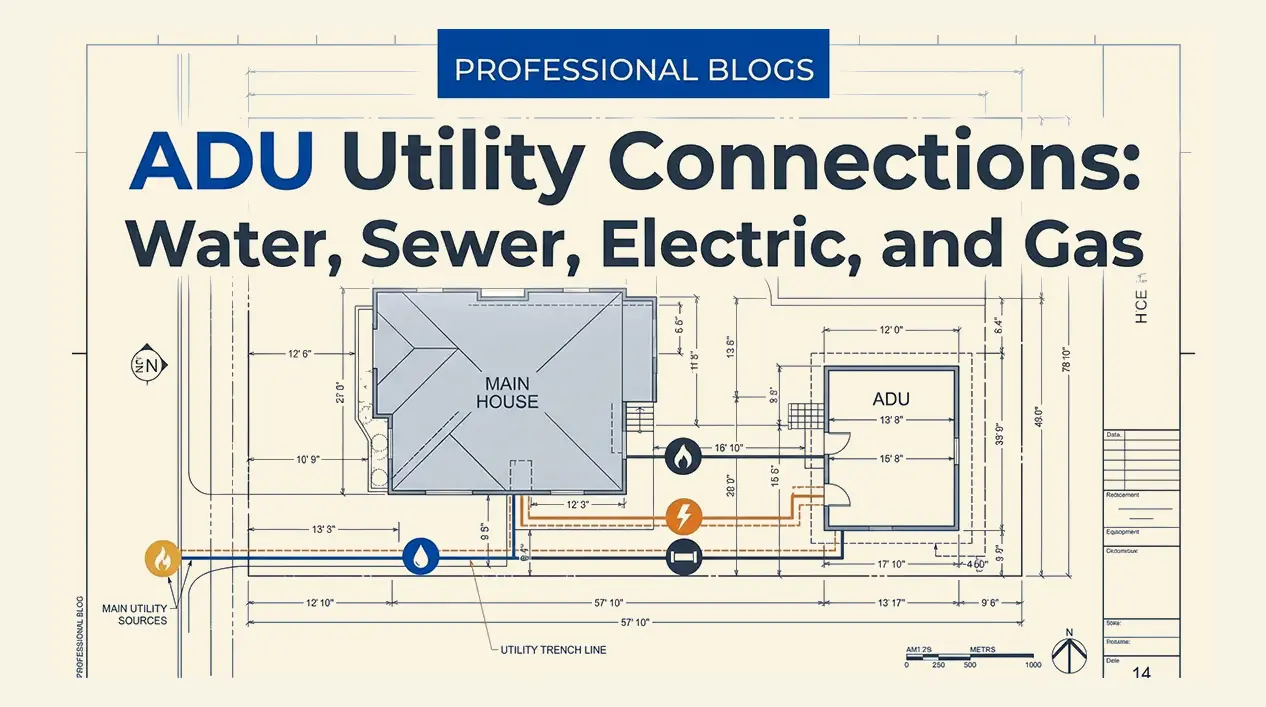
ADU Utility Connections, Water, Sewer, Electric, and Gas
You've figured out that your lot qualifies for an ADU. You've got a rough budget. Maybe you've even started sketching layouts. Then someone asks: "So how's water getting to it? Same line as the house, or does it need its own?" And you realize you haven't thought about utilities at all.
That's normal. Zoning and design get all the attention because they're the visible, exciting parts of ADU planning. Utilities are the unglamorous infrastructure underneath, and they can quietly make or break a project's budget and timeline if you don't look at them early.
Here's the core answer: yes, your ADU can share water, sewer, electrical, and gas connections with your primary house, California law protects that right, and for most lots it's the cheaper, simpler path. Shared utility connections typically run $9,000–$27,000 total; separate services cost two to three times that. Whether shared works cleanly for your property depends on distance, terrain, and what's already installed. Before you finalize your ADU design, this is the thing worth checking first.
The Big Picture: Utilities and ADUs
Four systems typically connect to any livable structure:
1. Water (supply)
2. Sewer (wastewater)
3. Electrical (power)
4. Gas (optional, heating, cooking, hot water)
For each one, you have two paths: shared, meaning your ADU ties into the same line as your primary house, or separate, meaning it gets its own dedicated connection back to the public main.
Which one makes sense depends on distance between the ADU and the house, what utility infrastructure already exists on your lot, requirements from your city or utility companies, and your budget.
California law protects your right to share utilities with an ADU. Cities can't require separate connections just because they'd prefer it. That's a meaningful cost saver, often $10,000–$30,000, and it's why shared utilities are the default path for most ADU projects. Some lots, though, genuinely need separate connections because of distance or capacity issues, and it's worth knowing which situation you're in before you design around the wrong assumption.
Water Supply for ADUs
Your ADU needs potable water, connected either to the public system or, in rural areas, a well.
Shared water line: Your ADU taps into the same line already serving your house. A plumber connects at or near the existing meter and runs a line to the ADU. Typical cost: $2,000–$5,000, depending mostly on distance. This requires adequate pressure and capacity in the existing line, which is almost always the case for residential water infrastructure, and works fine on a single meter, meaning one combined water bill.
Separate water line: Your ADU gets its own dedicated line run from the public main. Cost runs $5,000–$15,000 or more, depending on how far the main is from the ADU. People choose this route for cleaner separate billing, or occasionally because shared capacity genuinely doesn't work for the lot.
For most homeowners, shared water is the standard, no-downside choice. The situation where it gets complicated is distance: if your ADU sits 150+ feet from the primary house, running a shared line that far can get expensive enough that a separate line from the street ends up being the cheaper option instead. This is exactly the kind of thing to check with your water utility before you lock in a design, a quick estimate call tells you which direction makes financial sense.
Sewer / Wastewater for ADUs
Wastewater from showers, toilets, and kitchens needs somewhere to go, either the public sewer system or a septic system in rural areas.
Shared sewer line: Your ADU ties into the existing sewer line already running from your house to the street, typically running $2,000–$8,000 depending on distance and depth. In practice, this works for the overwhelming majority of properties, residential sewer lines are generally sized with headroom well beyond what one house alone uses, so adding an ADU's wastewater rarely pushes capacity limits.
Separate sewer line: A new dedicated line runs from the ADU to the public sewer main, typically $5,000–$20,000+. This gets chosen when the shared line is too far from the ADU's location to be practical, or in the rarer case where elevation makes a shared connection genuinely impractical.
Two technical wrinkles worth knowing:
- Distance and elevation matter. Sewer generally relies on gravity. If your ADU sits at a different elevation than the existing line in a way that defeats gravity flow, you may need an ejector pump ($3,000–$8,000), or a separate line designed around the elevation you actually have.
- Easements can block your plan entirely. If the existing sewer line runs through a recorded utility easement, you may not be able to build directly over it or route your ADU exactly where you'd planned. This is worth verifying before you get attached to a specific footprint.
Electrical for ADUs
Your ADU needs power for lighting, outlets, appliances, and heating or cooling.
Shared electrical service: Your ADU connects to the same main panel as your house, usually via an upgraded main panel feeding a new subpanel dedicated to the ADU. Typical cost: $3,000–$8,000, covering the panel work, subpanel, and wiring run. If your existing panel already has adequate capacity for both the house and a typical ADU load, the upgrade is often minor.
Separate electrical service: The utility installs a fully independent meter and panel for the ADU, typically $5,000–$15,000+. This gets chosen for completely separate billing and disconnects, a common preference if you're renting the ADU to a tenant who'll pay their own electric bill, though it's not legally required.
One thing that surprises a lot of homeowners: older houses with 100-amp electrical service are common, and adding an ADU usually pushes you to upgrade to 200-amp service, which is standard today. That upgrade runs $2,000–$5,000, easy to overlook until an electrician actually assesses your panel, but it's also a genuine improvement to your primary house's electrical capacity.
Whether shared or separate, code requires the ADU to have its own dedicated breaker and circuits, it's not sharing outlets or circuits with the main house even on a shared panel. That's a safety requirement, not a design choice.
Natural Gas for ADUs
Gas is optional. Your ADU can run entirely on electric heat, electric water heating, and an electric range, plenty of new ADUs do exactly that, especially given California's broader push toward all-electric construction.
If you do want gas, for heating, hot water, cooking, or a fireplace, the same shared vs. separate choice applies:
Shared gas line: Taps into your existing gas service, typically $2,000–$6,000 depending on distance.
Separate gas line: A dedicated line and meter from the utility, typically $5,000–$12,000+, again mostly relevant if you want fully separate billing for a rental unit.
Going all-electric sidesteps the gas question entirely, heat pump heating and hot water, electric range. It simplifies the utility plan (one less line to run) and lines up with where new construction in California is trending.
Can You Actually Share Utilities? (Legal and Technical Reality)
A few misconceptions come up often enough to address directly.
"Cities can prohibit shared utilities." Not true. California law protects the right to share water, sewer, electrical, and gas connections with an ADU. Some cities have tried to require separate connections anyway; state law overrides that.
"My lot is too small for utilities to reach." Depends entirely on the specifics. Most urban and suburban lots have utilities well within reach of any reasonable ADU placement. Rural properties further from main lines are the real edge case, worth checking directly with your utility companies rather than assuming either way.
"Sharing utilities will overload the system." Almost never the case. Municipal water mains, sewer lines, and electrical services are generally built with capacity headroom, and one ADU's added load is modest relative to that. The rare exception is a property where the primary house is already near the system's practical limit, which a utility company can tell you directly.
"Separate utilities are always the better choice." Separate connections cost roughly two to three times as much and add complexity. Shared is the more cost-effective, simpler default for most owner-occupied ADUs; separate mainly earns its cost when clean billing separation actually matters, like a fully independent rental situation.
The Utility Check Before You Design
This is the step people skip, and it's the one that saves the most money and stress if you do it. Before finalizing your ADU design, call each utility companies directly.
Get answers in writing where you can, an email confirmation is enough. These calls are free and take about half an hour total, and what you learn directly shapes your design and budget before you've spent money on drawings built around assumptions that don't hold up. Finding out early that your panel needs an upgrade or the sewer line runs through an easement you can't build over is a lot cheaper than finding it out after the design is done. This is exactly the kind of cross-utility check our MEP coordination service builds into the drawing process from day one.
Utility Easements: What You Need to Know
An easement is a legal right for a utility company to access their lines running through your property, you own the land, but they retain access rights to whatever's underneath or across it.
What that means practically:
- The utility can access their lines whenever needed for maintenance.
- You generally can't build permanent structures directly over an active easement.
- Trees, structures, and anything else that blocks access to the easement can be a problem.
Utilities commonly running through easements: water mains (often along the street), sewer lines (sometimes crossing the middle of a lot rather than just along the edge), electrical lines (overhead or underground), gas lines, storm drainage, and telecommunications lines.
If an easement crosses your intended ADU location, you generally have three options: build the ADU somewhere else on the lot that avoids the easement, request permission from the utility to build over it (uncommon, occasionally allowed for small, lightweight structures), or have the line relocated (expensive, and rarely approved for a project this size).
How to find out where easements sit on your property: pull your property title or deed (easements are typically listed), get a property survey (shows locations visually), call the relevant utility companies directly, or check property records at your city or county recorder's office. Confirming this before you commit to a specific ADU footprint can save you from designing around a location that was never actually buildable.
Common Questions About ADU Utilities
Can an ADU share utilities with the primary house?
Yes, California law protects this right for water, sewer, electrical, and gas. It's the standard, cost-effective approach for most ADUs.
Is sharing utilities cheaper than separate connections?
Generally yes, often by $10,000–$30,000 total. Separate connections mainly make sense for clean rental billing separation or when shared genuinely doesn't work for the lot.
What does shared water or sewer actually mean?
Your ADU's plumbing ties into the same line already running from your house to the street, rather than getting its own dedicated line back to the main.
Do I need separate electrical service for an ADU?
Not legally. Most ADUs run on a subpanel fed from the existing main panel, sometimes requiring a panel upgrade first. Separate service is a preference, not a requirement.
What's an easement, and does it affect my ADU?
An easement gives a utility company legal access rights to lines running through your property. If one crosses your intended ADU location, it can limit or block that specific placement, worth verifying before finalizing your design.
How much do ADU utilities typically cost?
Shared connections across all four utilities typically run $9,000–$27,000 total. Separate services can run two to three times that.
Can utilities reach my ADU if it's far from the house?
Often yes, but distance drives cost up quickly for shared lines. Past a certain distance, a separate connection to the street main can actually become the cheaper option, worth getting utility company estimates for both before deciding.
What if my property is on a hill?
Elevation change can affect water pressure and sewer gravity flow. A pressure-boosting pump or sewer ejector pump can solve either issue, typically $2,000–$8,000 depending on which is needed.
Do I need gas for an ADU?
No, it's optional. Many ADUs run entirely on electric heating, hot water, and cooking, which simplifies the utility plan.
How do I know if my lot can support an ADU's utilities?
Call your water, sewer, electrical, and gas providers directly before finalizing your design. Half an hour of phone calls answers most of the feasibility questions that would otherwise surface mid-project.
Utilities rarely make it onto a homeowner's early ADU checklist, but they're one of the few things that can genuinely block a project or blow up a budget if they're not checked early. The good news: for most standard lots, shared utilities work cleanly and keep costs well within the ranges above. The lots that run into real complications are usually the ones with distance, elevation, or easement issues, all things you can find out about with a few phone calls before you ever finalize your ADU design.
Related reading: California ADU Laws 2026 · Detached vs. Garage vs. JADU · ADU Permit Drawings · What "Permit-Ready" Means · The 60-Day ADU Rule · ADU Permit Packages