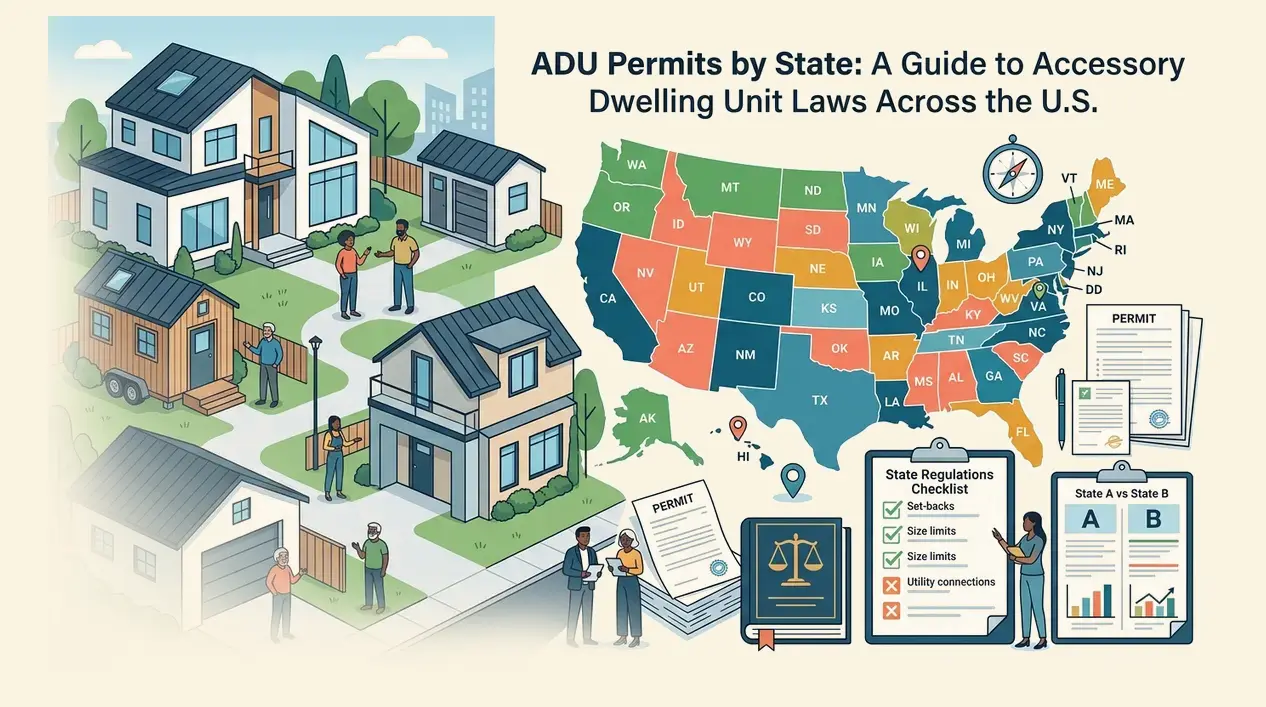
ADU Permits by State, A Guide to Accessory Dwelling Unit Laws Across the U.S.
California gets most of the attention when it comes to ADUs, ministerial approval, 60-day deadlines, statewide mandates cities can't dodge. If you live somewhere else, you've probably wondered where your own state fits into that picture. Is your state one of the ones catching up? Or is your city the one still deciding whether ADUs are even allowed?
The honest answer: it depends enormously on where you live, and this is a genuinely fast-moving area of law. A meaningful number of states have now passed statewide legislation requiring cities to permit ADUs, following variations on California's playbook. A larger group leaves the decision entirely to individual cities and counties, meaning your specific address matters more than your state. And in some places, ADU-friendly policy simply hasn't arrived yet, though the trend line nationally points toward more legalization, not less. Here's the landscape as it currently stands, with the caveat that follows you through this whole article: state and local ADU rules change frequently, so treat this as a starting map, not a final answer, verify directly with your state legislature and local planning department before you plan around anything here.
The National Landscape
ADU policy in the U.S. breaks down into three rough categories:
States with statewide mandates. A growing group of states, by most counts somewhere around 18 to 20 as of recently, have passed legislation requiring cities to allow ADUs, generally stripping away the biggest historical barriers: outright bans, mandatory owner-occupancy, excessive parking requirements, and discretionary (rather than ministerial) review. California, Oregon, and Washington are the longest-running examples; a wave of New England and Mountain West states have joined more recently.
States with local control, no statewide mandate. In these states, Texas is the clearest large example, there's no state law forcing cities to allow ADUs. Some cities within these states have adopted genuinely permissive local ordinances anyway; others haven't touched the issue, and some actively restrict ADUs through zoning. Here, your specific city matters far more than your state, which is exactly what a zoning and code research report confirms in writing.
States still catching up. A number of states, mostly with fewer major cities under housing-affordability pressure, haven't passed comprehensive statewide ADU legislation and don't have widespread permissive local ordinances either. ADUs may still be technically possible in individual cities, but the overall landscape is far more restrictive and inconsistent.
Even within states with strong mandates, HOA covenants and specific local zoning quirks can still complicate things, a statewide law generally overrides city zoning bans, but it doesn't automatically override private HOA restrictions on your specific property. That's always worth checking separately.
Why this is moving in one direction: a national housing shortage, growing interest in multigenerational living arrangements, aging homeowners wanting income or family flexibility, and, in a lot of states, genuine bipartisan interest in ADUs as a comparatively low-conflict way to add housing supply without large-scale rezoning fights. This is a real trend, but it's also genuinely still unfolding, and any specific list of "which states have passed what" is likely to be at least partly out of date by the time you're reading it. Verify current status directly.
States With Statewide ADU Mandates
These are states where legislation requires local governments to permit ADUs, generally removing outright prohibition, and often stripping out owner-occupancy requirements, excessive parking mandates, and discretionary review in favor of faster, more predictable approval.
| State | Notable Law / Context |
|---|---|
| California | The longest-running and most developed framework, SB 9, SB 13, AB 68, and related legislation have removed most barriers over multiple legislative cycles. |
| Oregon | Among the earliest strong statewide reforms, dating to 2017 and expanded significantly in 2019. |
| Washington | HB 1337 (2023) generally requires cities to allow at least two ADUs per single-family lot, without owner-occupancy requirements. |
| Colorado | Passed significant statewide ADU reform in 2024 (HB 24-1152). |
| Massachusetts | Adopted a statewide ADU mandate as part of a broader 2024 housing package. |
| Connecticut | Statewide ADU legislation passed in recent years, part of a broader New England reform wave. |
| Vermont | The 2023 HOME Act requires municipalities to permit ADUs in residential zones statewide. |
| Maine | Statewide legislation requires municipalities to allow multiple ADUs per lot. |
| Montana | A 2023 statewide law (upheld through court challenge) took effect in 2024. |
| Minnesota | Passed strong statewide ADU legislation in 2023. |
| Rhode Island | Adopted statewide ADU reform as part of a broader regional trend. |
| New Hampshire | An earlier mover (2017), though it generally leaves somewhat more discretion to local governments than the newer wave of laws. |
| Arizona | Statewide reform removing significant local barriers, generally counted among the more permissive frameworks. |
| Nevada, Maryland, Utah, Hawaii | Each has passed some form of statewide ADU legislation, with varying degrees of strength and local implementation still catching up in places. |
| Virginia | Recent legislation addressing ADUs, with effective dates and implementation details worth confirming directly given how recent this is. |
States With Local Control (No Statewide Mandate)
Texas is the largest and clearest example: there's no statewide ADU statute, and city ordinances vary enormously. Austin has adopted a notably permissive local program (its HOME initiative expanded what's allowed on residential lots). Houston's lack of traditional zoning creates its own distinct set of rules. Dallas and San Antonio each set their own local requirements. If you're in Texas, your city's specific ordinance is the whole story, the state itself isn't a factor either way.
Florida leaves ADU regulation primarily to counties and municipalities, though its 2023 Live Local Act introduced some statewide housing provisions that touch on ADUs as part of a broader affordable-housing push. South Florida counties tend to run more restrictive than some other parts of the state; local impact fees can also be a meaningful cost factor worth calculating early.
Georgia, Tennessee, North Carolina, and South Carolina generally follow the local-control pattern: no comprehensive statewide ADU mandate, but individual cities, Atlanta, Nashville, Charlotte, and others, have adopted their own progressive local ordinances independent of state action.
In any local-control state, the research question isn't "does my state allow ADUs", it's "does my specific city or county's zoning code allow them, and under what conditions." That's a call to your local planning department, not a state-level lookup.
States Still Working Toward Comprehensive ADU Policy
A number of states haven't passed broad statewide ADU legislation and don't have a widespread pattern of permissive local ordinances either. This doesn't necessarily mean ADUs are flatly illegal everywhere within the state, it usually means the landscape is inconsistent, restrictive by default, and dependent on finding the rare city that has proactively addressed it.
If you're in one of these states, expect: longer and less predictable approval timelines, more discretionary (rather than ministerial) review, a higher likelihood of needing a variance or special exception, and a real chance that your specific city simply hasn't built out a clear ADU pathway at all. This is also the group of states where things are changing fastest, legislative sessions add new ADU bills virtually every year, so a state that looks restrictive today may look meaningfully different within a couple of legislative cycles.
Why Some States Move Faster Than Others
A few patterns show up consistently in the states that have passed strong ADU legislation:
- Acute housing cost pressure, states and metro areas where housing affordability has become a serious political issue tend to move first, since ADUs are a comparatively low-friction way to add supply without large rezoning fights. - Urban-heavy population centers driving state-level policy, even when rural parts of the same state remain more resistant. - A track record from early movers. California and Oregon's results have functioned as a policy proof-of-concept that other state legislatures have referenced directly when drafting their own bills. - Aging homeowner populations interested in multigenerational living or aging-in-place arrangements, which cuts across the usual political lines in a way that's helped some ADU bills gain support in less obviously progressive states.
States that have moved slower tend to have stronger local land-use control traditions, less acute housing cost pressure, or simply haven't had an ADU-specific bill reach the floor yet, which is often more about legislative bandwidth and timing than a settled philosophical opposition.
How to Actually Research Your State and City
This is the part that matters more than any list, since lists like this one age quickly.
Step 1, check your state. Search "[your state] ADU law" and look specifically for the state legislature's own bill text or a state housing agency summary, not just a builder's blog post repeating older information. Confirm whether your state has any statewide requirement, and if so, what it actually mandates versus what it leaves to local discretion.
Step 2, call your city or county planning department directly. Ask plainly: "Do we allow ADUs? What's required, size limits, parking, owner-occupancy, setbacks? What's the typical approval timeline?" Get the answer in writing if you can. This single call often tells you more than any general research.
Step 3, check your deed and HOA. A state or city that broadly allows ADUs doesn't override a private deed restriction or HOA covenant that prohibits them on your specific property. Pull your title report and, if applicable, your HOA's CC&Rs before assuming anything is settled.
Step 4, talk to people who've actually gone through it locally. Neighbors, local builders, or a real estate agent active in your specific area can often tell you how permitting has actually gone for recent ADU projects nearby, which is a more reliable signal than a state-level classification.
Step 5, consider a local professional consultation if you're serious. A local land-use attorney or experienced local drafter can confirm feasibility for your specific lot for a modest consultation fee, often the fastest way to get a definitive answer rather than piecing one together from general research.
If Your State or City Doesn't Currently Allow ADUs
If your research turns up a genuinely restrictive local picture, a few honest options exist, roughly in order of how quickly they help:
Look for an alternative structure that isn't technically classified as an ADU. Some jurisdictions that restrict "ADUs" by name still permit guest houses, in-law suites, or interior basement conversions under different zoning categories, with different (sometimes less restrictive) rules. This is worth exploring with your local planning department directly, though it's genuinely case-by-case and depends on how your specific city's code is written.
Get involved in local advocacy if this matters to you long-term. ADU-focused nonprofits and housing advocacy groups exist in a growing number of states and can be a real lever for local policy change, city councils and state legislatures do respond to organized, informed constituent pressure, and this is genuinely how several existing state laws got passed.
Reassess your timeline rather than your goal. Given how quickly this area of law is moving nationally, a genuinely restrictive city today isn't necessarily restrictive in three or five years. If an ADU is part of a longer-term plan rather than an immediate need, it's reasonable to keep monitoring your local situation rather than assuming the current rules are permanent.
What's not a good option: building without proper permits in a jurisdiction that prohibits ADUs. Beyond the legal risk (fines, forced removal), an unpermitted structure generally can't be financed, insured, or legally sold, which tends to create far more expensive problems down the line than waiting for clearer local policy.
Common Questions About ADU Laws by State
Which states allow ADUs? Technically, ADUs exist in some form in every state, but whether your specific city allows them, and under what conditions, varies enormously. A meaningful group of states now have statewide mandates requiring cities to permit them; in most other states, it comes down entirely to your local zoning code.
Is my state ADU-friendly? Depends on whether your state has passed a statewide mandate (a growing list, but still well under half the country), and, even where it hasn't, whether your specific city has adopted a permissive local ordinance on its own.
What's the real difference between a state mandate and local control? A statewide mandate generally forces cities to allow ADUs and often removes specific barriers (owner-occupancy, excessive parking, discretionary review). Local control means each city decides independently, some will be genuinely permissive, others restrictive, within the very same state.
Can I build an ADU in a state without a statewide law? Often yes, if your specific city has its own permissive ordinance, this is common in larger, growth-oriented cities even in states without state-level mandates. It's a city-by-city question, not a state-level one, in these places.
Which states have the strongest ADU laws? California, Oregon, and Washington have the longest track records and some of the most developed frameworks. A newer wave of states, including Vermont, Maine, Montana, Minnesota, and Colorado, has passed comparably strong legislation more recently.
How do I research my specific state and city's laws? Start with your state legislature's actual bill text or a state housing agency summary, then call your local planning department directly for the specifics that actually govern your project, size limits, parking, timeline, and any owner-occupancy requirement.
Are ADU laws changing frequently? Yes, genuinely so. This is one of the more active areas of state and local legislation right now, with new bills introduced virtually every legislative session in multiple states. Anything you read, including this article, is a snapshot, not a permanent status.
What if my city prohibits ADUs even though my state allows them? If your state has a genuine statewide mandate, cities generally can't outright prohibit ADUs, but they can still shape requirements (size, parking, setbacks) within the bounds the state law allows. Confirm the specifics with your local planning department rather than assuming state law resolves every detail.
How long does ADU approval typically take? This varies enormously by jurisdiction, from a matter of weeks in strong ministerial-review states and cities, up to many months in places with more discretionary review or heavier backlogs. Ask your specific city directly rather than relying on state-level generalizations.
Will my state eventually allow ADUs if it doesn't now? The national trend points that direction, but this is a projection, not a guarantee, and the pace varies enormously by state. If ADU legalization matters to you, engaging with local advocacy or simply monitoring your state legislature's activity is a more reliable strategy than assuming a timeline.
---
ADU policy in the U.S. is genuinely a patchwork right now, genuinely permissive in a growing number of states, city-dependent in a larger group, and still catching up in others. The one constant is that this changes quickly, in both directions occasionally, but mostly toward more legalization over time. Wherever you are, the two calls that actually matter are to your state's current statute (not a summary from a few years ago) and to your local planning department directly.
Cadtri's expertise runs deep on California ADU law specifically, and we're glad to help homeowners in other states understand how their own state and city's requirements compare, and what a feasible, permit-ready design looks like wherever you're building.
---
Related reading: California ADU Laws 2026 · ADU Permit Drawings · Detached vs. Garage vs. JADU · The 60-Day ADU Rule · ADU Utility Connections · Title 24 Energy Code for ADUs · Can You Sell ADUs Separately? · permit drawing services