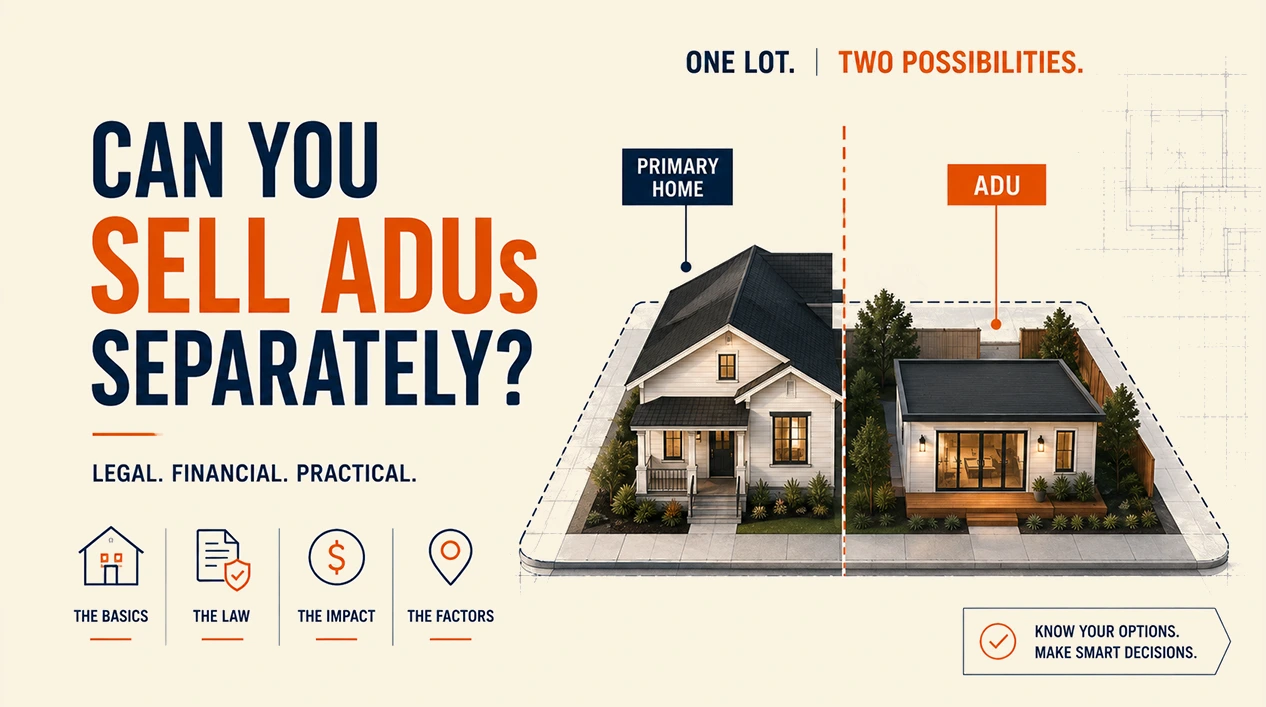
Can You Sell ADUs Separately? Legal, Financial, and Practical Considerations
You built the ADU. Or you're planning one. And somewhere along the way, the thought crossed your mind: could I sell this thing separately someday? Keep the house, sell the ADU, pocket the equity, or sell the ADU to one buyer and the house to another? It's a reasonable question, and until recently the honest answer was simply "no, not legally." That's changed, but only partway, and only in some places.
Here's where things actually stand. For most of California's history with ADUs, state law flatly prohibited selling an ADU separately from the primary house, they were legally tied together, no exceptions. That changed with a 2024 law, but it's opt-in city by city, and as of now only a small number of California jurisdictions have actually adopted it. So the real answer depends heavily on where your property sits, and whether your city has opted into the new framework at all. Selling both together remains the simplest, most universally available path. Splitting the lot the old-fashioned way is difficult and often denied. And the new condominium-conversion path under state law is real, but currently only usable in a handful of places. Here's how each option actually works.
The Short Answer
Selling the ADU and primary home together, as one property: Yes, always possible. No legal restructuring needed.
Selling only the ADU, primary home stays as-is: Historically prohibited outright by state law. As of a 2024 law (AB 1033), it's now possible, but only in cities that have specifically opted into the program, and most haven't yet. Worth checking your city's current status directly.
Splitting the property into two separate parcels (subdivision): Legally possible in principle, but expensive, slow, and frequently denied by cities that don't want to see ADU lots turned into standalone investment parcels.
The core concept to understand: an ADU is, by definition, "accessory" to a primary dwelling. That legal relationship is what historically made separate sale impossible, and it's specifically what the newer condominium-conversion law is designed to unwind, city by city, not statewide.
The Legal Basis: Why ADUs Historically Couldn't Be Sold Separately
The name gives it away: Accessory Dwelling Unit. Under the Planning and Zoning Law that governs ADUs statewide, an ADU exists on the same lot as, and legally subordinate to, a primary residence. For years, state law explicitly prohibited conveying, selling or otherwise transferring, an ADU separately from the primary residence.
That legal dependency is exactly why separate sale wasn't just difficult, it was flatly not allowed. A buyer couldn't get title insurance on a standalone ADU because the title itself didn't legally exist as an independent, sellable unit. Lenders wouldn't finance something that couldn't be cleanly titled. The structure was real, the value was real, but the separate ownership wasn't legally recognized.
What Changed: AB 1033 and the Condominium Conversion Path
Assembly Bill 1033, effective January 1, 2024, changed this, but only partially, and only where cities choose to act. AB 1033 amended state ADU law to allow (not require) local agencies to adopt ordinances permitting ADUs to be sold or conveyed separately from the primary residence, structured as condominiums under California's Davis-Stirling Common Interest Development Act.
How the process generally works where a city has opted in:
1. The ADU and primary residence are mapped as separate condominium units on the same parcel, a condominium plan is prepared and recorded.
2. CC&Rs (Covenants, Conditions & Restrictions) are drafted, governing how the two units relate, shared driveway, shared utilities if applicable, maintenance responsibilities, and so on.
3. A homeowners association structure is typically created, even for a two-unit property, to administer those CC&Rs.
4. The condominium plan is filed with the county recorder.
5. Once recorded, each unit, primary house and ADU, can be sold, financed, and titled independently.
Cost: Legal and filing costs for this process typically run in the range of $15,000–$30,000, covering the condominium map, CC&R drafting, HOA formation, and recorder filing fees.
The catch: this is entirely a local-option law. Cities and counties have to affirmatively adopt their own ordinance under AB 1033 for it to apply within their jurisdiction. As of now, only a small number of California jurisdictions have actually opted in, early adopters include San Jose, Santa Monica, and unincorporated San Diego County, with others actively evaluating the option.
Option 1: Sell the ADU and Primary Dwelling Together
This remains the simplest, most universally available path, regardless of what your city has or hasn't adopted.
How it works: you list the property as a whole, primary home plus ADU, both on the same lot, and sell it in a single transaction to a single buyer.
Advantages:
- No legal restructuring, no condominium process, no subdivision
- Properties with a legal ADU generally command meaningfully more than the primary home alone
- Appeals strongly to investor buyers looking for built-in rental income potential
- Available immediately, no waiting on city approvals or legal processes
Disadvantages:
- You can't cherry-pick, it's both structures or nothing
- Narrows the buyer pool somewhat, since not everyone wants a rental unit attached
- The transaction itself is a bit more complex to market and appraise than a standard single-family sale
A property with a well-built, legal ADU typically sells for meaningfully more than the primary home's standalone value plus the ADU's construction cost, the combination tends to be worth more than the sum of its parts.
Option 2: Traditional Lot Split / Subdivision
This is the older, more general-purpose path: legally subdividing your lot into two separate parcels, one for the primary home and one for the ADU, each with its own title.
How it works: you hire a surveyor to prepare a subdivision plan, apply to your city for lot split approval, and, if approved, each resulting parcel gets its own legal description and can be sold independently.
Typical costs: surveyor work ($2,000–$5,000), city application and processing fees ($1,000–$3,000), and often an attorney to guide the process ($2,000–$5,000), roughly $5,000–$13,000+ in total, though this varies significantly by jurisdiction.
Typical timeline: several months for surveying and application, plus city processing time that can run anywhere from a couple of months to closer to a year depending on the jurisdiction's backlog and appetite for approving splits.
The real barrier: many cities are reluctant to approve lot splits specifically for the purpose of separating an ADU from its primary residence. The policy reasoning behind ADU law was to add housing supply and gentle density, not to create new standalone investment parcels, and plenty of planning departments treat lot-split requests for this purpose with real skepticism.
Option 3: SB 9 Lot Splits and Two-Unit Development
SB 9 is worth understanding here because it's often mentioned in the same breath as ADU separation, but it's a related, distinct mechanism, not the same thing as the AB 1033 condominium path.
SB 9 allows an owner of a single-family zoned lot to pursue a ministerial urban lot split (dividing one lot into two) and/or convert a single-family property into up to two primary dwelling units, without the discretionary review that a traditional subdivision would typically require. It's a state law designed around adding modest density on single-family lots generally.
If your goal is genuinely to end up with two separately sellable units and your lot and city circumstances fit SB 9's parameters, it's worth having a real estate attorney or land use professional evaluate whether an SB 9 lot split fits your situation better than, or alongside, the AB 1033 condominium path.
The Financial Reality: Does Separating Actually Pay Off?
Before pursuing any separation path, it's worth running the numbers honestly, because separating isn't automatically the more profitable choice.
Selling together, no separation: Simple, fast, typically the highest combined sale price, since buyers pay a premium for a legal ADU attached to the primary home.
Separating (AB 1033 or lot split) then selling separately: You're paying $15,000–$30,000 (condominium path) or $5,000–$13,000+ (traditional lot split) upfront, on top of the time these processes take. And critically, an ADU sold on its own, without the primary residence attached, typically sells for less than its proportional share of what the combined property was worth.
The math that matters: add up the separation cost, subtract it from the combined proceeds of two separate sales, and compare that number honestly against what selling the whole property together would have brought in. For a lot of properties, selling together nets more money with far less complexity and cost. Separation tends to make the most financial sense specifically when you want to keep the primary home and only monetize the ADU, not as a way to maximize total proceeds from selling everything.
Deed Restrictions and HOA Rules
Two overlooked barriers can block separate sale entirely, regardless of what state or local ADU law allows.
Deed restrictions: Some older deeds carry language prohibiting accessory dwellings, multiple-unit structures, or similar restrictions predating current ADU law. A title report from a title company will surface these. If one applies to your property, it may need to be addressed before any separation, condominium conversion, or lot split can proceed cleanly.
HOA rules: If your property sits in a community governed by an HOA, the CC&Rs may restrict ADUs outright, restrict who can own one, or require board approval for any change in ownership structure. Review your HOA's CC&Rs directly and ask the board specifically whether separate ADU sale or ownership would be permitted, this is worth confirming well before you invest time or money in any separation process.
Title Insurance and Financing: Why You Can't Just Try It
Even setting aside whether your city has opted into AB 1033, attempting to sell an ADU separately without a legally recognized path in place runs into a hard wall: title insurance and financing.
Without a recorded condominium plan or a legal subdivision, there's no clean, independent title for the ADU to convey. Title companies won't insure something that doesn't have a legally recognized separate title, and lenders won't finance a purchase they can't insure. Buyers who might otherwise want the ADU simply can't complete the purchase, the deal falls apart regardless of how much interest exists, because the underlying legal and financial infrastructure isn't there.
This is exactly the gap that AB 1033's condominium process and traditional lot splits are designed to close.
The Rental Path: Often the Better Move
A lot of homeowners reach for "sell it separately" as the obvious way to extract value from an ADU, without fully weighing the alternative: keeping it and renting it out.
Rental income adds up over time, and the ADU itself typically continues appreciating in value right alongside the primary home. Compare that against the cost and complexity of separating and selling the ADU alone, legal fees, a lower standalone sale price, and giving up any ongoing income the moment it sells.
For most owner-occupants who aren't specifically pursuing an investment or development strategy, renting the ADU while holding the property, and eventually selling both structures together if and when you do sell, tends to outperform separating and selling the ADU on its own, both financially and in terms of complexity avoided.
The Practical Timeline: When Can You Actually Sell?
Selling both together: Immediately, anytime after the ADU is complete. No waiting, no approval process.
Traditional lot split: Realistically several months to the better part of a year, assuming your city approves it at all, and a meaningful share of these requests are denied outright.
AB 1033 condominium conversion: Only available at all if your city or county has adopted the local ordinance. Where it's available, expect the condo mapping, CC&R drafting, HOA formation, and recording process to take a matter of months.
Renting instead of selling: Available immediately, and ongoing for as long as you choose to hold the property.
Should You Plan for separate sale From the Start?
If you're building an ADU now and wondering whether to design around an eventual separate sale, here's the honest framing.
For most homeowners, the more reliable strategy is: build the ADU, rent it out for income (or use it for family), and if you eventually sell, sell the whole property together. This is simple, doesn't depend on your city adopting new ordinances, and typically produces solid financial outcomes without any legal complexity.
If separate sale is genuinely a goal, the smart move is confirming your city's current AB 1033 status (or evaluating an SB 9 path with a land use attorney) before you finalize your ADU's design, not building first and trying to retrofit a separation strategy onto a completed structure. Design decisions like unit access, utility separation, and unit configuration are all much easier to plan for upfront than to correct after the fact.
Common Questions About Selling ADUs Separately
Can I sell just the ADU without the primary home?
Only if your city or county has adopted an AB 1033 ordinance enabling condominium conversion, or you've completed a legal lot split. Without one of those in place, state law doesn't recognize a standalone ADU title to sell.
What's the easiest way to sell an ADU separately?
Where available, the AB 1033 condominium conversion process is generally the more straightforward and increasingly common path compared to a traditional lot split, but it only exists in jurisdictions that have opted in.
How much does it cost to separate the property?
Roughly $15,000–$30,000 for an AB 1033 condominium conversion (legal, condo mapping, HOA formation, filing), or $5,000–$13,000+ for a traditional lot split, though both vary by jurisdiction and property complexity.
Will my city approve a lot split or AB 1033 conversion?
It depends entirely on your specific jurisdiction. Traditional lot splits for this purpose are often denied. AB 1033 conversion is only available where your city or county has affirmatively adopted the ordinance, confirm directly with local planning staff.
Is separating and selling more profitable than selling both together?
Usually not, once you factor in separation costs and the typically lower standalone sale price for a unit sold without the primary residence attached. Selling together, or renting long-term, often nets more.
Can I just rent the ADU instead of selling it?
Yes, this remains available everywhere in California and is often the financially stronger choice compared to the cost and uncertainty of separating and selling the ADU independently.
What happens if I try to sell an ADU separately without a legal path in place?
The sale generally can't close. Title companies won't insure an ADU without a legally recognized independent title, and lenders won't finance a purchase they can't insure, buyers who are otherwise interested simply won't be able to complete the transaction.
Selling an ADU separately from the primary home has gone from flatly impossible to conditionally possible, but "conditionally" is doing real work in that sentence. It depends on your city adopting AB 1033, or successfully navigating a lot split that plenty of jurisdictions resist approving. For most homeowners, selling the whole property together, or renting the ADU for ongoing income, remains the simpler and often more profitable path.
Related reading: California ADU Laws 2026 · Detached vs. Garage vs. JADU · ADU Permit Drawings · Title 24 Energy Code for ADUs · ADU Utility Connections · a complete ADU permit set