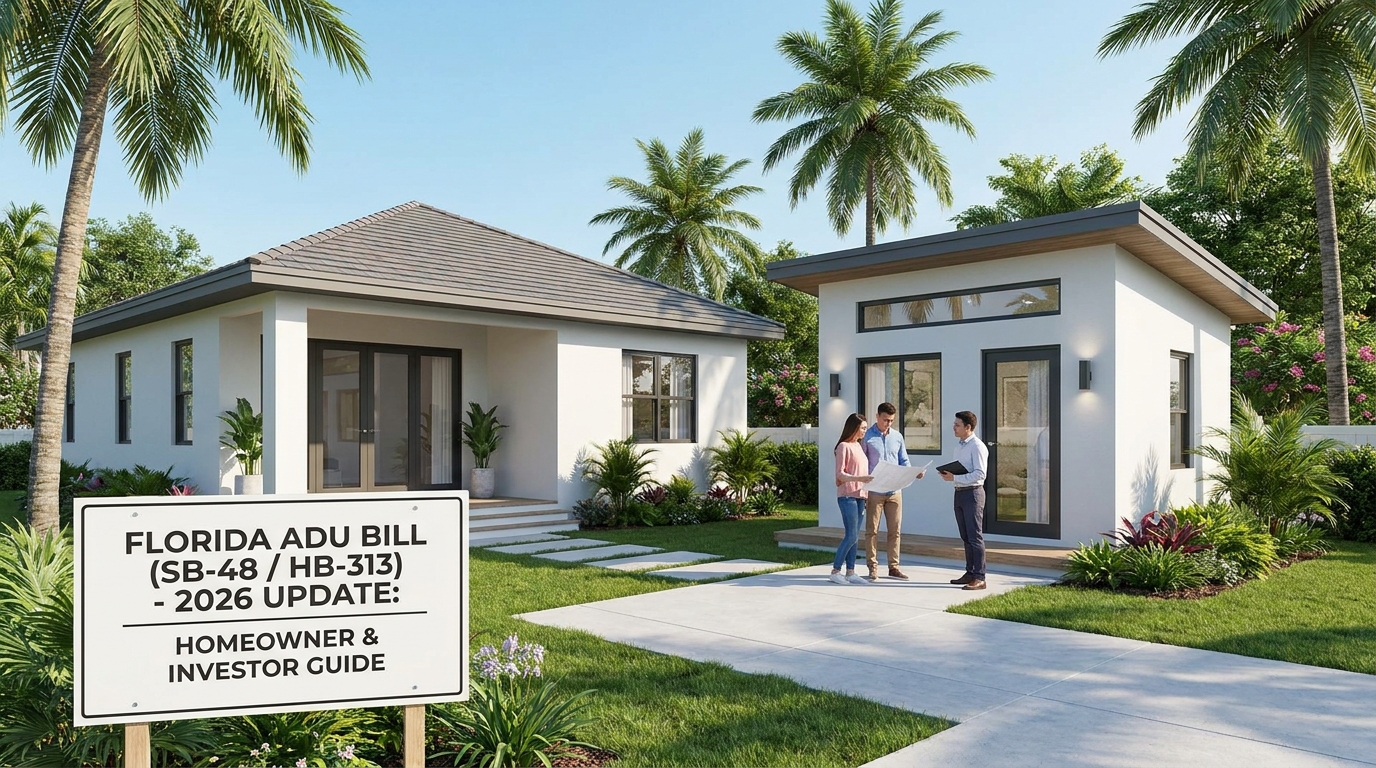
Here is the headline nobody selling you an ADU floor plan wants to lead with. As of mid 2026, Florida does not have a new statewide ADU law. The bill that was supposed to deliver one, Senate Bill 48 and its House twin House Bill 313, passed the Florida Senate 38 to 0 and then died in the House on March 13, the final day of session. It is the second year in a row that the same idea has come within arm's reach of becoming law and slipped away at the buzzer.
That single fact changes everything about how a smart Florida homeowner or investor should be planning right now. Most of the blog posts ranking for "Florida ADU law 2026" get it flat wrong, writing as if the rules already changed. They have not. But the direction is unmistakable, and the gap between what almost passed and what is enforceable today is exactly where the opportunity lives.
What SB 48 and HB 313 actually were
An accessory dwelling unit, whether that is the backyard cottage, the garage conversion, the in law suite, or the "granny flat," is a second, smaller home on the same lot as your primary residence. Florida already has a statute on the books, Florida Statutes 163.31771, but it only authorizes local governments to allow ADUs. It does not require them to. The result is a 67 county patchwork where some places welcome ADUs and others bury them under owner occupancy mandates, oversized minimum lot rules, and discretionary hearings that drag on for months.
SB 48, filed by Senator Don Gaetz, set out to flip that one word, from authorize to require. Had it passed, every city and county in Florida would have been forced to adopt an ordinance by December 1, 2026 allowing ADUs by right in any zone that already permits single family homes. By right is the phrase that matters. No special exception, no neighbor showdown at a public hearing, no discretionary approval. Meet the building code and you build.
The bill went further than just unlocking the door. It would have banned blanket owner occupancy requirements, so you would not have to live on site to add or rent an ADU. It would have limited how small cities could cap ADU size, with a proposed floor that stopped localities from setting a maximum below 75 percent of the primary home's floor area or 1,200 square feet, whichever is smaller. (You will see "1,000 sq ft" cited around the web as if it is settled law. It is not in the statute, and the figure shifted between drafts.) It would have curbed restrictive parking rules that quietly make ADUs impossible on normal lots. And it would have protected your homestead exemption, since adding a rental ADU would not strip your Save Our Homes cap. The rented portion would simply be assessed separately and taxed by its use.
Cities would still have kept real authority over setbacks, height, design standards, impact fees, and short term rental rules. The law was always meant to set a floor, not a ceiling.
Why it keeps dying
If the policy is so popular it cleared the Senate without a single no vote, why is it 0 for 2? One word again. Rentals. The fight that killed both the 2025 and 2026 versions was over whether cities could block ADUs from being rented for stays under 30 days. The Senate wanted to give municipalities that power. The House balked. The clock ran out. It is a genuinely thorny disagreement, since vacation rental politics in Florida are their own contact sport, and until the two chambers settle it, the broader ADU mandate keeps going down with the ship.
The momentum is not going anywhere, though. Reform is widely expected to return in the 2027 session, and the bipartisan margins suggest it is a matter of when, not if. AARP's research keeps pointing the same way, with a large majority of older adults saying they would consider living in an ADU. Florida's housing math of high prices, an aging population, and multigenerational households practically writes the bill's talking points for it.
What is actually true for your parcel today
So where does that leave you in 2026? Right back with current law, which is better than the doom posting suggests, but it means the rules depend entirely on where your property sits.
In Tampa, Orlando, Miami, Jacksonville, and dozens of other jurisdictions, ADUs are already permittable today, each under its own local zoning code, layered on top of the Florida Building Code. The variation is enormous. One city allows a detached cottage by right on a standard lot, the next restricts ADUs to a single high density zoning category, a third still enforces an owner occupancy clause that SB 48 would have wiped out if it had passed. Knowing which bucket your parcel falls into is the whole game.
There are two things SB 48 would not have touched, and that still bind you regardless of any statewide reform. The first is HOA and deed restrictions. Private covenants are not preempted by the ADU statute, and Florida courts consistently enforce a properly recorded restriction over municipal zoning. If your HOA prohibits accessory structures, a green light from the city does not help you, so pull your deed and HOA declarations from the county clerk before you spend a dollar. The second is the physical site limits like impervious surface ratios, septic drainfield capacity, flood elevation, and setbacks. These are engineering questions, not legislative ones, and they are the same with or without a new law.
Why this is the moment to plan, not later
Here is the part that turns a frustrating "the bill died" story into a genuine head start. Two clocks are running at once.
First, in most of Florida's major metros you can build an ADU right now under existing rules. You just have to navigate them parcel by parcel. Second, if statewide reform lands in 2027, demand and permit volume will spike overnight, and the owners who already have a feasibility study and a code compliant set of drawings in hand will be the ones breaking ground while everyone else is still reading blog posts.
The expensive mistake is waiting for a law that may or may not arrive on schedule, when the binding constraint on your project was never the legislature. It is your specific lot's zoning, your HOA, and a permit ready plan set. That gap exists today, independent of Tallahassee, and it is the one worth closing first.
Whether you are eyeing a detached backyard build, weighing a garage conversion for the most cost effective path, or trying to figure out if your lot even qualifies, the sequence is the same. Confirm what is allowed, then design to it. A focused zoning and code research report tells you exactly what your jurisdiction permits today and where reform would change the math. A feasibility study layers in the site realities like impervious surface ratio, septic, and setbacks before you commit. And when you are ready to pull a permit, a complete ADU permit package gets you from "I think I can" to "I am approved." For the full picture of what we draft across the state, see our residential services.
The bottom line
There is no new Florida ADU law in 2026. SB 48 and HB 313 died in the House, and the statewide by right mandate is parked until at least the 2027 session. But Florida's ADU statute, Section 163.31771, already lets local governments allow them, and many of the biggest markets do. The owners who win are the ones treating this moment as a planning window, not a waiting room.
Thinking about an ADU? Get a free zoning and feasibility check for your Florida parcel. Find out exactly what you can build today, and what changes the day reform passes.