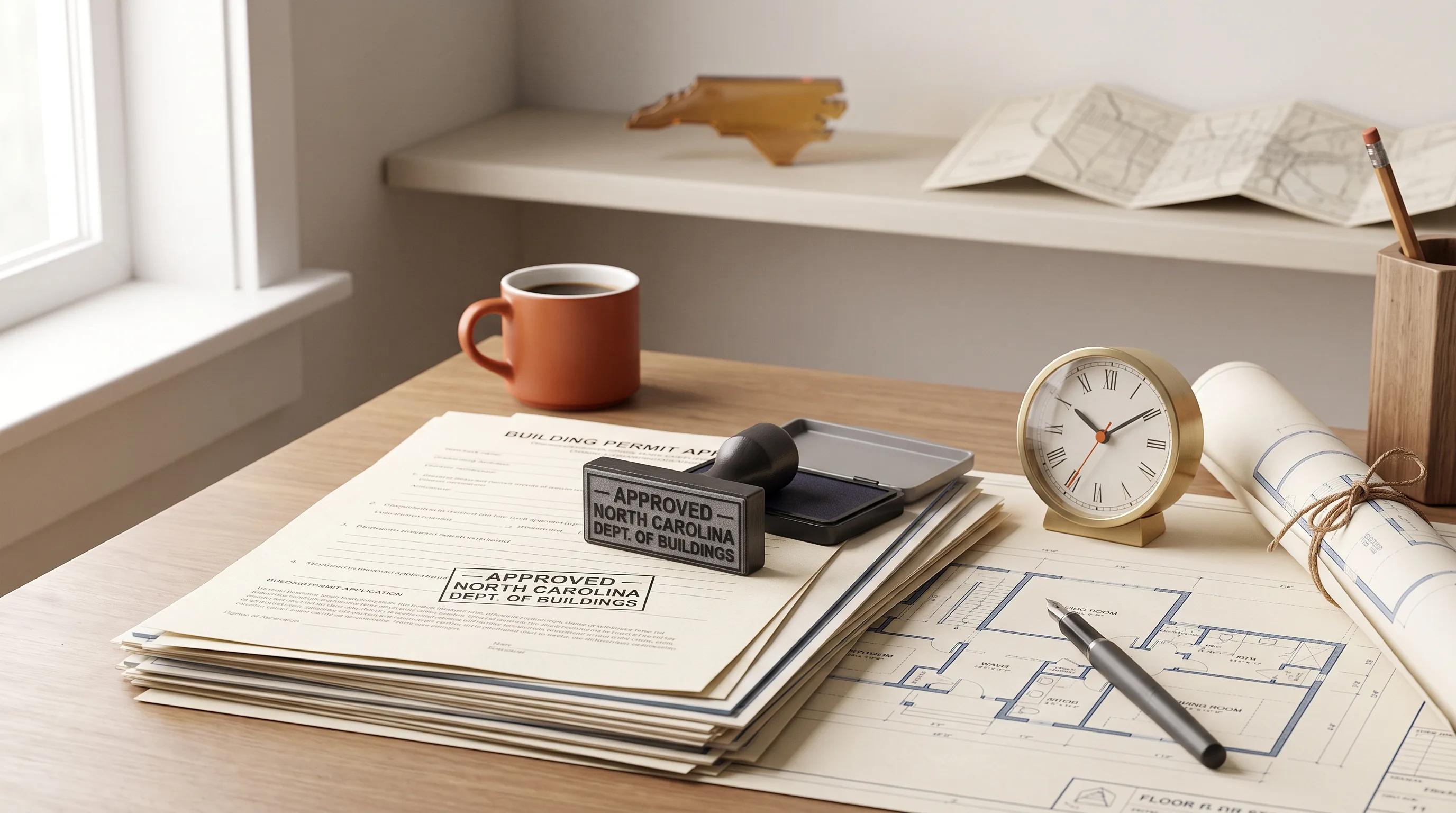
Getting a building permit in North Carolina is more predictable than in a lot of states, because the code is set at the state level and applied fairly consistently from the mountains to the coast. But predictable does not mean simple. The permit itself is issued by your city or county, the timeline swings based on which office you walk into, and the delays that blow up a schedule are almost always avoidable ones that started long before you hit submit. Here is how the process actually works in 2026, what to expect on timing, and where projects get stuck.
Do you even need a permit?
For most construction in North Carolina, yes. New homes, additions, structural changes, decks above a certain height, and anything involving electrical, plumbing, or mechanical work all require a permit before work begins. There is a narrow break for minor residential work. State law generally lets jurisdictions skip the permit requirement for small residential jobs valued under 40,000 dollars, things like swapping windows or a minor fixture change, though the trade work inside those jobs can still trigger its own permit. When in doubt, the safe assumption is that you need one, because building without a permit is the kind of mistake that surfaces at resale, when an unpermitted addition can stall or sink a sale.
Who issues the permit
North Carolina permits are handled locally, and the dividing line is your city limit. If your property sits inside an incorporated city or town, that municipality usually issues the permit. If it sits in unincorporated county land, the county does. The arrangement varies, though, and the two biggest markets show how.
In Charlotte, the city does not run its own building department. Permitting and inspections are handled by Mecklenburg County Code Enforcement, which serves as the inspections authority for both the city and the county and is one of the largest such operations in the state. Raleigh, by contrast, runs its own inspections department with an online portal that handles most residential applications, while properties in unincorporated Wake County go through the county. The practical lesson is that "North Carolina" is not your jurisdiction. Charlotte, Raleigh, Mecklenburg County, and Wake County each have their own application, fee schedule, and queue, and confirming which office owns your parcel is step one.
The NC building code, and a wrinkle worth knowing in 2026
Every permit is reviewed against the North Carolina State Building Code, including the North Carolina Residential Code for one and two family homes, which is the state's amended version of the International Codes. Here is the part many guides get wrong. As of 2026, the edition in force is still the 2018 North Carolina State Building Code. The 2024 update was originally set for January 2025 but has been delayed repeatedly, most significantly by the Disaster Recovery Act of 2025 passed in the wake of Hurricane Helene, which paused the new code until the state finishes publishing it and seats the new Residential Code Council. The upshot is that you are almost certainly designing and permitting to the 2018 code right now, although an owner can request the 2024 code as an alternative method of construction. If a contractor or plan tells you otherwise, that is a flag worth checking before you submit.
Step by step: how the process runs
The path from idea to certificate of occupancy follows the same basic arc in every jurisdiction.
It starts with your application and a complete plan set submitted through the local portal. For a one off custom home in Mecklenburg County, for example, that means the residential plan review path, with zoning and erosion control forms uploaded alongside the drawings. Then comes plan review, where the jurisdiction checks your documents against the building code, the local zoning ordinance, and any stormwater, erosion, or utility rules that apply. If the package passes, the permit is issued and you can break ground. From there you move through a sequence of required inspections as the build progresses, and only after the final inspections pass does the jurisdiction issue the certificate of occupancy that legally clears the home to be lived in.
That inspection sequence for new residential construction is long and ordered. Expect footing, then foundation or slab, then framing, followed by the rough ins for electrical, plumbing, and mechanical, then insulation and energy, and finally the separate finals for electrical, plumbing, mechanical, and the building itself. Erosion control and other site specific checks can layer on top. Each one has to pass before the next phase proceeds, which is why a single failed inspection can ripple through a schedule.
How long does a permit take in NC?
This is the question everyone wants answered, and the honest version has two layers: the legal floor and the real world range.
The legal floor is set by state law. Jurisdictions are generally required to begin their initial review within a defined window, with residential building plans under the Residential Code reviewed on a tighter clock than commercial work, and there are refund consequences when local governments miss those statutory timelines. That is the start of review, though, not the finish.
The real world range is wider and depends on the office and your project. In the Triangle, residential permit review across the major jurisdictions has been running roughly 10 to 30 business days in early 2026, and the City of Raleigh specifically has typically taken about 15 to 30 business days for a complete residential application. Durham has reported much faster turnarounds, in the 5 to 10 business day range, for straightforward projects like a deck. The single biggest variable is completeness. A clean, coordinated submittal moves; an incomplete or inconsistent one gets kicked back, and a return for revisions commonly adds two to four weeks before you are even back in the queue.
The delays that actually hurt, and how to avoid them
Almost every serious permitting delay in North Carolina traces back to a handful of causes, and they are largely preventable.
The most common is an incomplete or inconsistent submittal, where the structural drawings, the site plan, and the stormwater details do not line up. Reviewers cannot approve what does not reconcile, so the package bounces. Submitting a coordinated set, where structure, site, and drainage all agree, is the most reliable way to avoid round trips. The second is zoning. The building code and the local zoning ordinance are separate gates, and a design that satisfies the code can still fail a setback, height, or lot coverage rule, so the zoning review needs to happen before the drawings are final, not after. A third is alternative or unusual construction. Methods like ICF, SIP, or timber frame are allowed, but they require engineering and manufacturer documentation, and unfamiliar jurisdictions can add several weeks of review. Finally, there is simple jurisdiction confusion, applying to the wrong office or to the wrong code path, which costs time you never get back.
The throughline is that the permit timeline is mostly decided before you submit, in the quality and coordination of the package. The build does not wait on the city nearly as often as it waits on a drawing that should have been complete the first time.
Plan it before you submit
The fastest permit is the one that clears review on the first pass, and that outcome is engineered upstream. Knowing your exact jurisdiction, the live code edition, the zoning constraints on your specific lot, and the required submittal contents before you apply is what separates a two week approval from a two month one.
That is the work to front load. A permit pathway analysis identifies the correct jurisdiction and code path and maps the documents your specific project needs. A code and compliance review checks the design against the 2018 NC code and your local ordinance before anything is submitted, and a coordinated permit set gives reviewers a clean, reconciled package that does not invite a revision cycle. You can see the full scope of what we prepare on our residential and commercial pages.
Starting a project in North Carolina? Get a permit pathway analysis before you submit. It is the cheapest way to keep weeks of review delay off your schedule.
If your project is an accessory dwelling unit specifically, see our ADU permit process guide for permit requirements across Florida, Texas, and North Carolina.